Arrival Checklist for International Students in Australia: Tick the Box & Enjoy Your Journey
03 March 2026

It is undoubtedly a wonderful sensation to reach our destination country like Australia after months of hard work and preparations. After all, you are in your news house full of surprise and thrills. Since the first moment you step in the airport everything has changed. And you need to get ready to go with the flow. To help you with that, we have made an arrival checklist for international students in Australia. Start your journey now!
Before You Leave the Airport

As soon as you land in the airport in Australia, you need to gird your loins to collect everything and move fast!
Clear immigration and keep all important documents safe
You must first pass through immigration and customs when you land at an Australian airport. It is required to fill out an incoming passenger card, which is typically provided to you on your flight.
Remember to keep critical documents, such as IDs, passport and visa documentation, carefully during and after your border clearance.
Collect your luggage and check nothing is missing
Watch the information monitors in the baggage claim area to locate the carousel number assigned to your particular flight. Wait and carefully collect your luggage on the carousel.
It is advisable to find a less crowded place nearby so that you can easily and closely check your luggage. If your luggage is misplaced, damaged or missing any items, you can go to the airline’s baggage service counter to submit a claim.
Connect to airport Wi-Fi and message your family
It would be nice of you to notify your folks back home that you have arrived safely right after you?ve picked up your stuff. You can use the airport Wi-Fi to connect and contact your family if you haven’t set up your home or internet in Australia yet.
Arrange safe transport to your accommodation
Before you fly to Australia, it is best to find out how to get to your lodging from your arrival airport. You can look into local transportation choices or research the official airport pickup service offered by your university.
Some educational institutions offer their own shuttle or airport pickup services, which is a dependable and safe way. Or, you can find a train/bus station or order a taxi or a ride-sharing service to get to your place on your own.
Overall, with preparation and research, you can quickly get to your accommodation from the airport. It would be beneficial because after a long flight, you truly need to rest.
Arrival Checklist for International Students in Australia
Now it is time to look at the checklist and see what to do to build your new life in Australia as an international student.
Settle into your accommodation?
If you haven’t made arrangements for long-term lodging in advance, the University’s Accommodation Service is the first place to go for help locating proper housing.?
Homestays, residence halls at universities and shared apartments are typical choices for lodging. Obviously, staying with relatives or friends is more comfortable as you already have a well set-up place. Also,on-campus accommodation is very common and convenient. Yet, if this is your first option, be sure to apply well in advice due to its great demand.?
If you are not living on campus or with family and friends, you can join an existing shared home or rent a private flat through a registered real estate agent. Importantly, you have the same rights as any other tenants in Australia as an international student, including:
- Right to a safe and healthy living environment??
- Right to privacy?
- Right to end the tenancy?
- Right to protection from discrimination?
In addition to rights, you have some legal obligations as a tenant. These include adhering to the conditions of your lease, paying your rent on time, and maintaining the property in a fair condition.
Set up your mobile phone & Save important emergency numbers??
Setting up your phone is the next thing to do. It is crucial to have a movie phone connection with quality mobile internet packages so you can stay in touch with your family back home and people you meet in Australia.
Conveniently, most Australian mobile network providers allow you to purchase a SIM card even before you set foot in the country. When you arrive, you just need to go to your provider?s on-site branch to activate the SIM card.
Within a few minutes, the service will be ready to use. Then, you can find and save some important emergency numbers like the emergency hotline (000), helplines from your university, your landlord (if any) and so on.
Open an Australian bank account

Opening an Australian bank account is really important for many reasons like receiving or transferring money at preferable rate, access to various local banking services, etc
Several banks like Westpac, ANZ, Commonwealth Bank, and NAB provide account choices designed uniquely for international students. These tailored accounts will give you special deals and benefits as an international student.
Just like a SIM Card, you can open one online prior to your arrival in the country. Yet, you are only allowed to use it after you verify your identity at the bank?s branch.
Learn how healthcare works??
To access a proper healthcare service in Australia, international students must hold an Overseas Student Health Cover (OSHC) policy during their time in the country.?
OSHC is a healthcare insurance plan that helps cover any hospital and medical services international students may require while in Australia. It is also a requirement for you to be granted a student visa, which means without it, your visa application will be denied.
You must notify your OSHC provider as soon as you arrive in Australia. So, they can activate your insurance policy and give you a membership card to use right away. Besides, you need to research any clinics or hospitals near your accommodation and which one is covered by your insurance. That makes sure your money on insurance is spent for the right place.
For any healthcare-related issues, you can contact your OSHC provider for help and clarification.
Apply for a Tax File Number (if you plan to work)
If you plan to work a part-time job, it is vital to learn the terms of your student visa regarding employment. According to the law, you have the same rights and responsibilities as native workers.
One of the most important points is paying taxes. International students who earn income are bound to pay a sum of taxes. To be successfully registered to pay tax, you must have a Tax File Number (TFN). In the Australian tax system, a TFN is your personal reference number that most employers will need from you before allowing you to work.
Your passport, an Australian address, a phone number, and a working email address are required to apply for a TFN.?
Set up your myGov account and link key services
With a myGov account, you can connect to and use a variety of online government services in one location. It is best to use a strong or standard identity strength when setting up using myID to create an account. This is the safest way to sign in to myGov.?
Besides, you can utilise 2-factor authentication, either an SMS code or the myGov Code Generator app, along with your email to access your account.?
After creating your myGov account successfully, you are able to connect to key government services such as Centrelink, Medicare and the Australian Taxation Office.?
Explore your local neighborhood (shops, transport, essentials)

Once you have finished all of the above stuff, you can take some time to explore your local neighborhood. This is not only for your entertainment purposes but also for researching missions.?
?For example, you can familiarize yourself with the public transports and learn to use them to commute to school (if they are your primary travelling options). Remember that each major city in Australia has its own public transport card and app. So, be sure you would obtain the right one in your city.
Besides, while you are getting around your place, try to locate supermarkets or convenience stores where you can get food and other essential stuff. If you are with friends, it is definitely great to have them as your tour guide to show you some nice entertaining places. Enjoy your time before your first week at the university.?
Your First Week: Study & Life Setup
Your first week at the university is important as you will get to learn how to spend your 4 years there.
Get your student ID card
Obtaining your student ID card is the first thing you must do. You can get your student ID card from the Student Center once your enrollment in your units is complete. When requesting your student card, please make sure you have a picture ID with you.
You can use your student ID card to access campus buildings, computer suites and printers. Furthermore, this card will give you many other student benefits like borrowing books from the library and discounts on fees when travelling by public transportation.
Attend orientation and welcome sessions
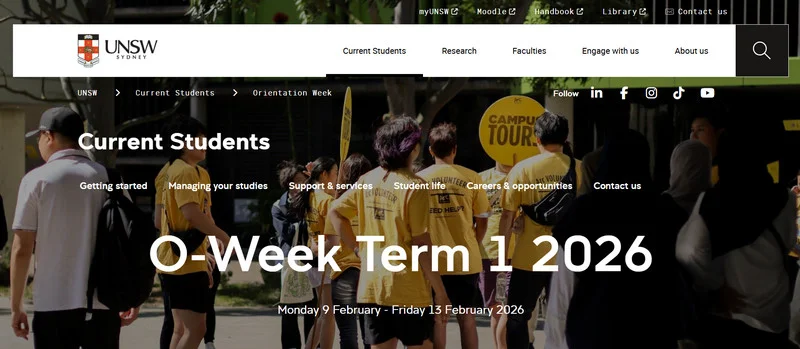
As you may be aware, all universities have an orientation week (a.k.a O-Week), at the start of each academic semester. International students are required to attend Orientation. The event includes various social and academic activities to welcome students to the new academic year.?
Orientation gives you a chance to learn about the campus, how the university operates and meet with staff and other students. Above all, it is an opportunity to have fun.
After arriving, make sure you contact your university and participate in all of their welcome and orientation events. These programs are essential in educating you about your responsibilities and rights as an overseas student in Australia.?
Set up your learning tools (student email, portals, Wi-Fi, library)
You can attend your Faculty Course Advisory Session held during the Orientation. They provide important information about your course and other study stuff, like:
- Activating your student email account
- Accessing the university’s online portal to stay updated about the course and school.?
- Connecting to the free WiFi at the university, which is fast and helps you save money
- Signing up for a library card which allows access to the entity online or in-person to find materials for your study.

These things are to help you cope with your study like homework or projects and obtain all the benefits tailored to the students only.
Plan your timetable & weekly routine
It is necessary to try your hardest to get used to the time change when you first arrive in Australia. You will thank yourself later once you are able to adjust to the time difference.?
After that, you can plan a new timetable for your study and part-time job (if you plan to work). It is best to maintain a work-study balance because if you fail to fulfil your academic requirements, your visa status will be in danger. Just remember that your goal when coming to Australia is to gain knowledge and degrees, not making money.
Besides, you should spend some time on other activities outside work and school like exercises or entertainment. Try taking up some daily sport or recreative routine like cycling, picnicking to recharge your energy. This would help you relieve stress and study better!?
Join clubs and communities to make friends
Meeting new people and building relationships are? crucial aspects of adjusting to your new life. Participating in the university?s free social programs is a terrific way to meet new people.
For example, the University of Adelaide offers the following clubs:??
- Talking with Aussies: A one-on-one English conversation program
- Language and Cultural Engagement: Regular social events to practice languages and explore cultures??
- Global IQ Connect: Programs where you can meet people to enhance your intercultural skills
- CommuniTea: A weekly event to enjoy a snack and chat with other students?
Besides, there are hundreds of sporting clubs and other interest-based clubs like cultural clubs, religious clubs, politics clubs, academic clubs, arts clubs, and more.
Overall, joining a sports team and/or student club is a great way to meet new people outside of your class to learn and embrace our intercultural differences. Importantly, it is a safer way to make new and right friends than wandering around your city or meeting people through social apps.
Create a simple budget for living costs in Australia
According to the Department of Home Affairs, holders of student visas would save up at least AUD 29,710 for living expenses each academic year. You should set aside about AUD 6,000 for the initial expenses of establishing yourself.
Initial costs could consist of:?
- Public transportation?
- Food and beverages?
- First month?s rent (in advance) and bond (usually one month?s rent) for long-term accommodation
- Textbooks and stationery?
Get ready to find a Job?
To support your financial condition, you can find a part-time job. However, you first need to learn about the part-time work rules for international students in Australia. Make sure you understand your rights and requirements to apply for a job.
In fact, every major city in Australia has a robust job market for international students. The good news is that they are always hiring. Some of the most common job sectors include:
- Hospitality Jobs (Waiters, Cashiers or Receptionists at restaurants, cafes, and hotels)
- Retail Jobs (Salesman or Cashiers at supermarkets, clothing stores and electronic outlets)
- Administrative Roles (Customer service, Call center representative, etc.)
In addition to offering financial assistance, these jobs can help you develop a professional network and gain experience in the Australian job market. As long as you know your rights and compliances, you can well maintain your work along with your study.
Wellbeing & Culture Tips for New International Students
This part will give you some tips to deal with some internal issues like your feelings and wellbeing. Staying mentally healthy is not easy when you are far from home and into a whole new world!
Managing homesickness and culture shock

It can be frightening when studying far from your home country. It is no big deal when you get culture shock. The only thing that matters is that you are not alone as many other international students experience the same thing and they have successfully conquered it. That means you can do it too!?
Based on our true experiences, here are some tips to help you cope with homesickness and culture shock:
- Talk to other international students to find the same sense of detachment
- Be confident to open up about your real feelings or problems with friends or staff members
- Take time to embrace the differences?
- Distract yourself from homesickness by joining clubs or sport activities with friends
Staying safe online and in your new city
There are a lot of things you can do online from communication, banking to researching information. The good side of it is that it is really convenient. However, you need to be cautious.?
Many scammers are targeting international students as they are fragile for newly moving to the country. You may not be familiar with everything here and get trapped by the wrongdoers. The tips are only using trustworthy online sources and find support from the official establishments.
Besides, in real life, you also need to be careful when living and studying in your new city. Some things to do are:
- Try to travel with a friend or in a group
- Leave valuables at home if they are unnecessary
- Never carry a lot of cash
- Call 000 in the event of an emergency
Where to get help?
As for international students, you can easily get help from different organizations for different issues related to your study, work, life or legal status in Australia. Here are some of the common places where you can find support:
- University’s Accommodation Service: They help with your landlord, roommates, rental agreement or any other issue related to your accommodations.
- Tuition Protection Service: They help students get a refund or loan re-credit for training and education they paid for but did not receive, or help continue your education through another course or different provider.
- International Student Office: They offer services and advice on visa and immigration, cultural adjustment, etc.
- Students’ Union: The officers can help support you if you experience discrimination.
- Fair Work Ombudsman: They help you follow the laws that make all workplaces equal and fair.
Additionally, you can find help from your individual partners like your personal bank or your migration/education agent for relevant issues.??
Printable / Downloadable Arrival Checklist (PDF / Google Doc)??
For your convenience, we have created a printable/downloadable arrival checklist in Australia. You can use this one as your guide or create your own one based on this. Then, you can follow the list and tick the box as your journey goes. Have fun!
Wrapping Up
It can be daunting to move to a new country, but you must keep in mind that you are not alone. You can seek support from other international students who have been in the same situation and understand how you are feeling now.
Also, we are here to help you too! This arrival checklist for international students in Australia is made with love and real experiences that could help you navigate your new life.?
Wish you all the best on your new journey!
FAQs
- What you can (and can’t) bring into Australia?
You should know what you can and cannot carry into Australia because of the country’s stringent border regulations. It has tightened its biosecurity regulations, and failing to accurately declare biosecurity commodities at the Australian border will result in penalties. Visit the Australian Border Force website to learn what you can and cannot bring.
- Is it hard to make an international phone call to your family back in your home country?
No, it is not. Many Australian mobile network providers offer special deals for international students when it comes to international calls and roaming. Your mission is to find the most suitable option for yourself. Besides, you can utilize the free WiFi to connect with your family, which could save up a lot!
- How to cope with your jet lag and adjust to a new time zone when you first arrive in Australia?
After you arrive, you should get back to your accommodation as soon as possible. Start unpacking necessary things and lay down a little bit, which could help with jet lag. To adjust your new time zone, you could try to stay up when you are sleepy or try to sleep when not tired. The more disciplined you are, the better it gets. Eventually, you will be fine!

My name is Moni, and I am a seasoned PTE teacher with over 6 years of experience. I have helped thousands of students overcome their struggles and achieve their desired scores. My passion for teaching and dedication to my students success drives me to continually improve my teaching methods and provide the best possible support. Join me on this journey toward PTE success!